Hasselt University students visit SER Curaçao as part of exchange program on export promotion
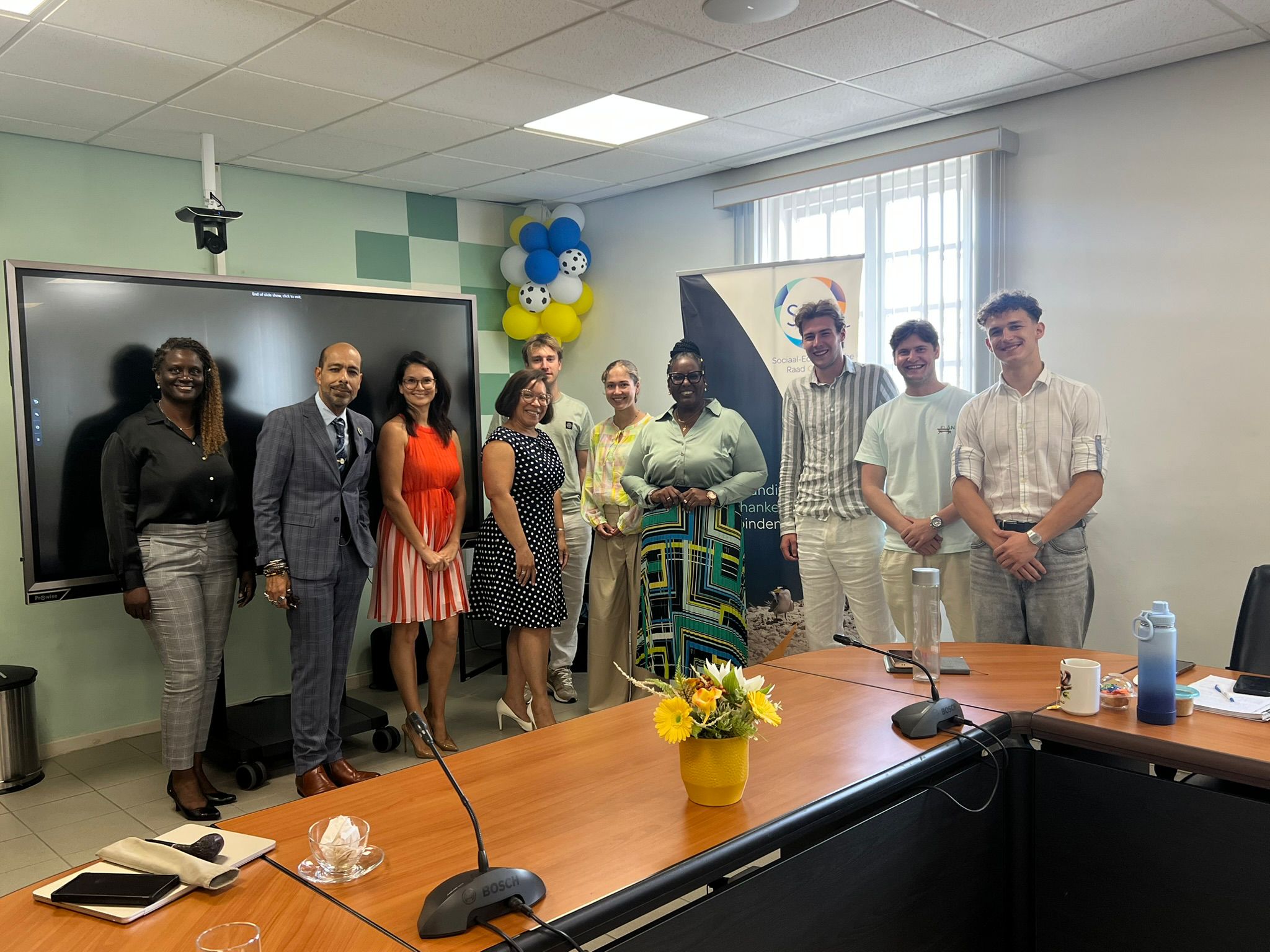
Willemstad, July 3, 2026 – The Social and Economic Council (SER) of Curaçao recently welcomed a group of students from Hasselt University in Belgium for an introductory working visit. The visit was part of a two-week exchange program in Curaçao, during which the students, commissioned by the Ministry of Economic Development, are developing a plan aimed at strengthening Curaçao’s export position.
The exchange program gives students the opportunity to connect academic knowledge with the practical realities of Curaçao. Through meetings, working visits and substantive sessions, they are gaining insight into the country’s economic, institutional and social context. In addition to their assignment on export promotion, the students are visiting several organizations that play a role in the development of Curaçao’s economy.
During their visit to the SER, three themes were central: the constitutional relations within the Kingdom of the Netherlands, the role and working methods of SER Curaçao, and the country’s current socioeconomic situation. The discussion addressed Curaçao’s position as an autonomous country within the Kingdom, the importance of consultation and advisory processes in policymaking, and the main economic and social challenges facing the country.
A key part of the meeting focused on the role of the SER as an independent advisory body to the government and Parliament. The students were introduced to the Council’s tripartite structure, in which representatives of employers, employees and independent experts jointly examine socioeconomic issues. Attention was also given to the advisory process and to the way in which the SER contributes to broadly supported policy making on matters of public importance.
The meeting also addressed Curaçao’s wider socioeconomic structure. Issues such as demographic developments, labor-market challenges, economic diversification, competitiveness and Curaçao’s position as a small, open economy were discussed from the perspective of export promotion. The session underscored that efforts to stimulate exports cannot be separated from productivity, entrepreneurship, institutional capacity and international positioning.
For the students, the visit offered an opportunity to place their assignment within a broader policy and societal framework. Export development requires more than market analysis and economic strategy. It also calls for an understanding of governance structures, social interests and the policy conditions that shape sustainable economic growth in Curaçao.
By welcoming the students, SER Curaçao contributes to the exchange of knowledge between Curaçao and international educational institutions. Such encounters provide students with valuable practical experience while strengthening the dialogue on the future of Curaçao’s economy.
SER Curaçao looks back positively on the visit and emphasizes the importance of cooperation among education, government and civil-society organizations. By linking theory and practice, new insights can emerge that contribute to sustainable socioeconomic development.