Press release
Structural Behavioral Change Central in SER Exchange on Recycling Policy
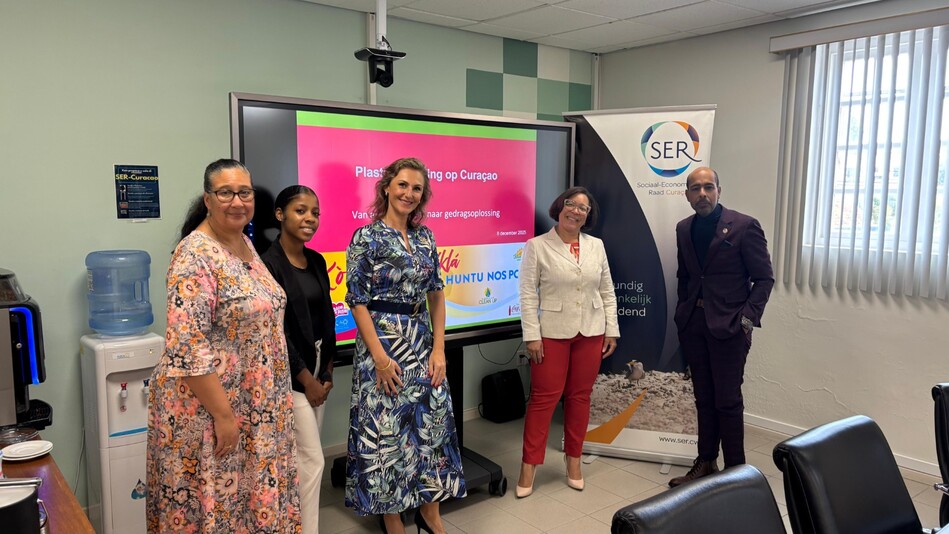
Willemstad, February 26, 2026 – During a recent exchange with the technical Secretariat of the Economic and Social Council (SER) of Curaçao, the role of behavioral change within future recycling policy was central. In this context, Myrthe George-Verhulst presented her research and program “Plastic Recycling in Curaçao – From Waste Problem to Behavioral Solution.”
In her presentation, George-Verhulst outlined the urgency of the situation: the landfill site is expected to reach its maximum capacity within five to eight years, while waste volumes continue to increase due to population growth, consumption, and tourism. At the same time, only a limited share of plastic is currently being effectively recycled. For the SER, this issue constitutes an important point of attention within its broader advisory role concerning sustainable development, quality of life, and Curaçao’s economic resilience.
George-Verhulst emphasized that the core of the problem is not primarily a lack of infrastructure, but rather a lack of structural behavior. In 2026, recycling capacity will be expanded from seven to twelve recycling centers. However, without targeted behavioral change, this expansion will not automatically result in substantially higher recycling rates.
The presented program is based on behavioral science research, including an ACDR analysis (Architecture, Competence, Drivers, Resistances) conducted by the Behavior Change Group, observations at recycling centers, and a quantitative survey among residents of Curaçao. The conclusion is clear: most people are willing to recycle, but face too many practical barriers, lack of clarity and routine, and have insufficient trust in the system.
The program translates these insights into one integrated behavioral ecosystem consisting of 65 concrete interventions, structured around five pillars: making recycling extremely easy; removing doubt; linking recycling to fixed routines; activating pride and identity; and strengthening system trust through transparency.
For the SER, this issue is relevant not merely as an environmental matter, but because it touches upon multiple socio-economic policy domains for which the Council carries an advisory responsibility. The waste problem affects the livability of residential neighborhoods, the island’s tourism appeal, international sustainability commitments, and Curaçao’s reputation as an investment and business location. Implementation also requires public-private cooperation, co-financing, and institutional anchoring — issues that directly align with the SER’s advisory mandate.
George-Verhulst called for shared responsibility and structural cooperation between government, the private sector, civil society organizations, and educational institutions to make recycling the new social norm in Curaçao.
“The question is not whether we must act,” said George-Verhulst, “but how quickly we are collectively willing to realize this in a sustainable manner.”
The SER emphasizes that such research insights provide valuable input for future advice on waste policy and behavioral interventions, in which social dialogue and cooperation between public and private stakeholders are essential.