Press release
SER takes closer look at proposed Sports Fund for Curaçao
WILLEMSTAD — The Social and Economic Council (SER) has issued a formal advisory opinion to the Minister of Education, Science, Culture and Sport (OWCS), Sithree “Cey” van Heydoorn, on a draft national decree, containing general measures, for the Curaçao Sports Fund. The opinion was delivered on Monday, Dec. 1, 2025.
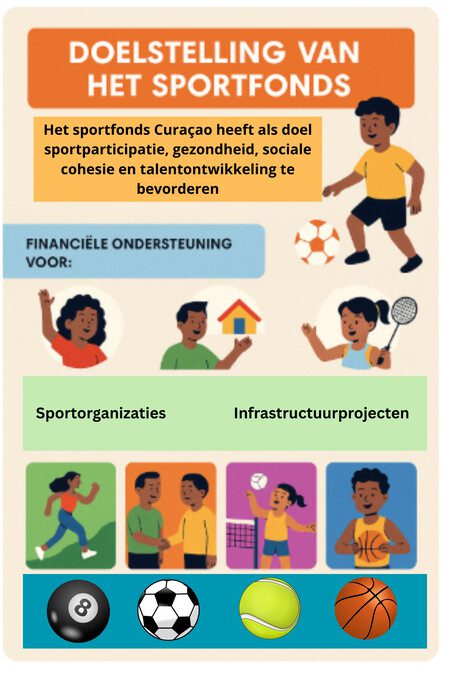
With the draft decree, the government aims to create a clear legal and administrative framework for how public funds for sports are raised, allocated and accounted for. The Sports Fund is intended to strengthen the social role of sports — from neighborhood facilities to elite competition — and to support public policy at the intersection of health, social cohesion and talent development. The proposal sets out, among other things, the fund’s objectives, eligibility criteria for applicants, the procedures for assessing applications and the rules governing reporting and disclosure.
The draft decree builds on the National Ordinance Sport Fund Curaçao (P.B. 2021, no. 120) and would allow sports financing to be structurally tied to earmarked statutory revenues. Those include, in particular, a 3 percent levy on the gaming sector under the National Ordinance on Games of Chance (LOK), collected through the Curaçao Gaming Authority (CGA) and paid into the fund, on top of existing sports budgets and the historically relevant special excise on gasoline. In this way, the Sports Fund is designed to act as a hub for different public funding streams for sports, channeling them through a single framework for applications, awards and accountability.
In its opinion, the SER examines the proposed fund along three main lines. First, the council conducts a legal review, looking at the delegation basis in the Sports Fund Act, the relationship between the act and the decree, the internal logic of the draft text and its place within the broader body of Curaçao’s legislation, including the Country Ordinance Government Accounts 2010 and Financial Management acts. At the center of that analysis is the question of whether the proposed rules remain within the mandate of the formal legislature, and whether decisions on awards can be made in a way that is legally reviewable and consistent with the rule of law.
Second, the SER performs a budgetary and risk-focused analysis. It examines the sources of the fund’s revenues — gaming proceeds, the gasoline excise and general tax funds — as well as the multi-year budgetary impact and the sensitivity of revenues to economic swings. Classic fund-related risks, such as the accumulation of unspent balances, double financing of projects and opaque financial flows outside the view of Parliament and the public, are addressed directly. The council also looks closely at internal controls: how powers are distributed between the minister, the managing committee and the secretary, and how oversight, reporting and audit would be organized within the government’s ordinary financial management system.
The third line of analysis concerns the socioeconomic and policy dimension. The SER places the Sports Fund against a backdrop of rapid population aging, the high prevalence of chronic diseases and rising health-care costs. The advisory explores how sports and physical activity — through targeted projects in neighborhoods, at sports clubs and in schools — can help improve health outcomes, support labor market participation and productivity and bolster social cohesion. It also considers whether a dedicated fund could function more effectively than a patchwork of separate subsidy schemes, and what kinds of indicators, monitoring arrangements and evaluation cycles would be needed to keep the use of public money verifiable over time.
The council grounds its work in a broad concept of welfare: progress is measured not only in economic growth, but also in social well-being, quality of the living environment and sustainable development. Within that framework, the Sports Fund is viewed as an instrument to make public spending on sports — and thus on health and social cohesion — more transparent, predictable and open to scrutiny. The SER examines the full chain: from the legal foundation in the act, through the detailed provisions of the decree and the budgetary integration, to the practical implementation in neighborhoods, by sports organizations and other applicants.
In its advisory to Mr. van Heydoorn, the SER does not take a position on whether the Sports Fund should ultimately be created in the exact form currently envisioned. Instead, the council sets out what it describes as the key questions that the government must answer: Is the fund empowered to do what the regulation seeks to achieve? Is the financing structure sustainable over the medium term? And does the proposed design demonstrably create public value? That three-part lens — legality, fiscal sustainability and socioeconomic effectiveness — forms the core of the SER’s analysis and, the council says, should guide the minister and the government in their further deliberations on the Curaçao Sports Fund.